Ongoing
2021 - Present
City-Scale Traffic Behavior Analysis and Simulation
Understanding city-scale traffic behavior and optimization of micro-mobility rearrangement while estimating greenhouse gas emissions.
Traffic Analysis
Simulation
Sustainability
Overview
Shared micromobility systems (SMSs) are paving the way for new travel options while potentially lowering transportation-related greenhouse gas (GHG) emissions. However, few studies have used real-world trip data to quantify these environmental benefits. This project aims to understand city-scale traffic behavior, classify trip purposes, and estimate GHG emission reductions from shared mobility systems.
Approach
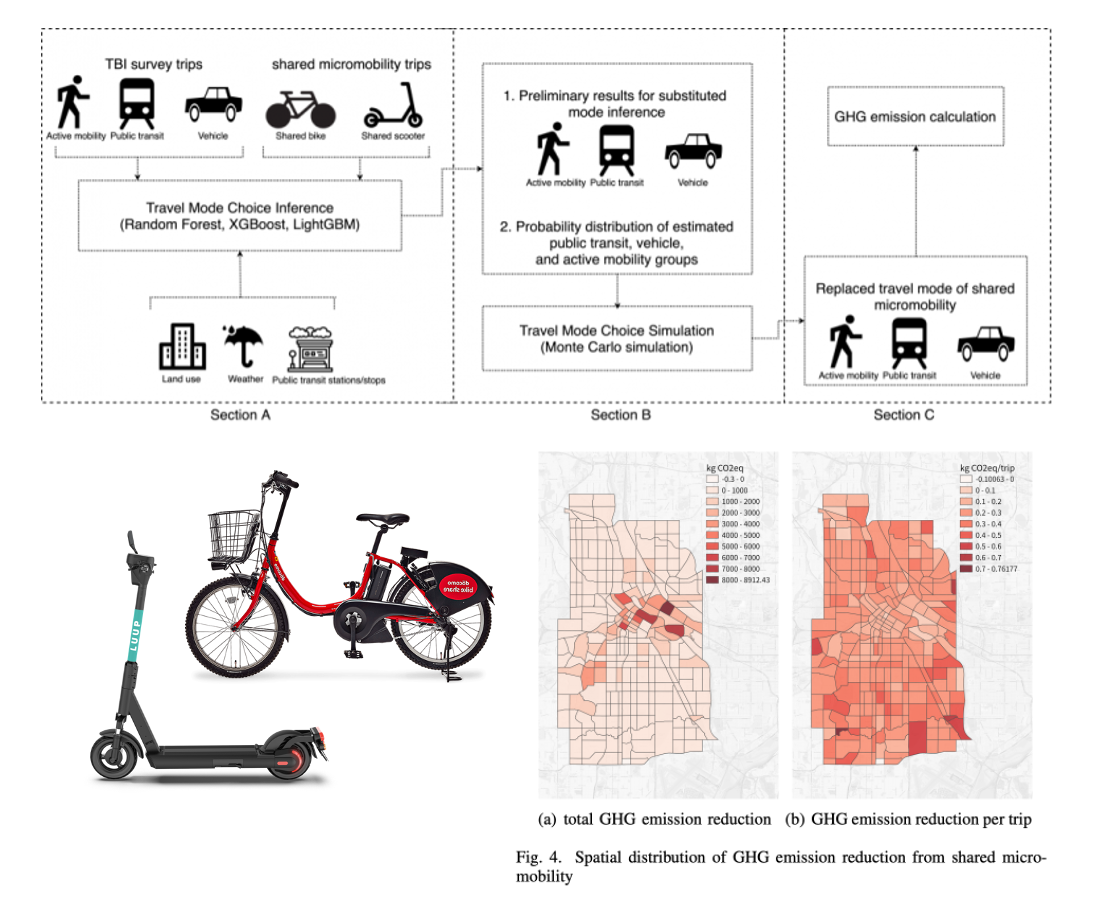
- GHG emission estimation (Sustainable Cities and Society 2022): Machine learning algorithms (Random Forest, LightGBM, XGBoost) to identify travel mode choice preferences and estimate modes substituted by shared micromobility trips, combined with Monte Carlo simulations for probabilistic GHG reduction estimation
- Trip purpose classification (UbiComp 2022): Plug-in Memory Network (PMN) using non-negative Tucker decomposition and cross-attention mechanisms for privacy-preserving trip purpose inference from spatial activity information
- User mobility pattern analysis (ITSC 2021): Non-negative tensor factorization for unsupervised discovery of characteristic user mobility patterns from dockless e-scooter sharing data
Results
- Environmental benefits: Confirmed that SMSs have positive environmental impacts and potential to facilitate decarbonization of urban transport; obtained probabilistic outcomes considering uncertainty levels
- Trip purpose classification: PMN outperformed baseline models and demonstrated strong tolerance through missing data tests using only spatial information
- Mobility patterns: Successfully identified characteristic user mobility patterns and clusters from e-scooter data in Chicago and Washington D.C.
Significance
This research provides quantitative evidence that shared micromobility systems contribute to urban transport decarbonization. The privacy-preserving trip purpose inference and unsupervised mobility pattern analysis offer scalable tools for urban transportation planning and infrastructure optimization.